Monday, 18 September 2023

Building the Mantuan Succession

Our hero the Chevalier di Recci is a Savvoyard, well known at the court in Turin.  The Duke considers Recci as a useful tool.  So far I have some of the figures done, but I'm lacking the battlefield.

Savoy

For the last century or more Savoy, with its capital at Turin, has attempted to maintain its independence from its rapacious French and Spanish neighbours, as wel as local rivals such as Monferrat, Mantua, Milan and Genoa.  The Duke maintains a small standing army and relies on his nobles to provide its officer Corps.
Turin itself is beset by spies from both sides as we as rivalries among its petty nobles and merchants.

The Small idea!

Battle will take place on a 2ft square template.  This is a small scale skirmish not Pileman's Lament.  Our scene is Savoy and its surroundings, and the Italian cities are my start point.

The buildings

Marking up the foamcore board

And house number one, clearly marked as such!


Hardboard base template
Foamcore walls
Wooden stick windows and doors.

3 sets of houses,  each of 3 stories.  Russian dolled to fit inside each other.  One as a city gate maybe?
Empty backed for floor levels and interiors. The backs slide in and out.
Sewer entrances as manhole covers.  Underground passages.

26 cm by 12  (three buildings)
22 cm by 10 (two buildings)
Maybe a single building or Church with churchyard. 

Wheels, ladders, washing lines, fountain, statue, wagon, barrels, market stalls.

One of the things I've learned from the Pulp! Rules is to think about skirmish movement in 3D.  The rooftops and sewers will be available to characters.

House number two on its base template.

The first row of houses, ready for plaster, pva and paint.

And the City buildings, all eight, awaiting plaster sand and pva as the next stage.


The crowds

On a mass template with 4 figures minimum.  Crowds direct the action and swarm towards a good fight unless a firelock is discharged.

4 types of crowd
Nobles parading their status
Dodgy Rakes and Poncy Bravos
Merchants selling cloth
Peasants and farmers selling carrots.
Smuggler types selling knock off gear.

Scenario ideas

To the swordsmith, purchase a new blade
Escort the Venetian banker across the city
Unmask Fr Peccato, the smuggler and bandit
Prevent the Assassination of Prince Charles
Discover the French spy
Rescue the dodgy Milady de Weiner
Intercept the Duchess love letter
Deliver the Duchess love letter
Observe 
Kill the trouble maker Scaramouche
Arrest the trouble maker Scaramouche
Avoid arrest by the Red Guard.
Capture General Déspair of Mantua
Destroy the Milan gate using gunpowder
Meet the Cardinal's Agent
Guide the Compte to his lawyer
Disrupt the duel between the Comptes.

M. de Tréville,
"S’blood! Messieurs Musketeers, I will not have this haunting of bad places, this quarreling in the streets, this swordplay at the crossways..."


The noble houses and Archbishop's of Turin, my political bit.

Marquesa Broglia 
Compte Milliet 
Compte Battista
Compte de Monte Pubis
Compte di Campo
Baron Ferrero,
Baron Vacante 
Baron Provana 
Chevalier Bergera 
Chevalier Beggiamo 
Chevalier Vibò 
Chevalier Gattinara

Archbishops
Carlo Broglia (1592–1617)
Filiberto Milliet (1618–1625)
Giovanni Battista Ferrero, O.P. (1626–1627)
Sede vacante (1627–1632)
Antonio Provana (1632–1640)
Giulio Cesare Bergera (1643–1660)
Michele Beggiamo (1662–1689)
Michele Antonio Vibò (1690–1713)
Sede vacante (1713–1727)
Gian Francesco Arborio di Gattinara, B. (1727–1743)

Great Plague of Milan
 Italian plague of 1629–1631
The Great Plague of Milan in 1629–31 killed an estimated 60,000 people out of a population of 130,000. This episode is considered one of the last outbreaks of the centuries-long pandemic of plague that began with the Black Death.


Character List

The Chevalier Di Recci  "Flasque" de Bladé, and his faithful manservant Lurkio.
The Papal Nuncio, Cardinal Poncé
Brother Quentin, the Confessor (admits to everything).
Geno, Compte de Campo
Isabella The Marquisa Campo, his daughter
Captain Quim, Spanish Captain with goatee beard
The Scarecrow, aka Friar Syn, notorious overacting Rabble Rouser
Father Baskerville, The Crime Fighting Monk.
General Ignorancé of Turin
General Déspair of Mantua
Das Gross Baron de Weiner
Milady de Weiner, Spy
Tarquin, La Compte de Monte Pubis
Captain Diego Vigo Alatriste, in the Army of His Most Catholic Majesty of Spain.
Rupprecht di Orso, Captain of the Duke of Savoy's Guards
Colonel of the 1st Turin Musketeers
Alberto Bertorelli, Captain of the Papal Nuncio 's Swiss Guard Pikemen
Moreau the pamphleteer, who leads a double life as Scaramouche, actor and Righter of Wrongs
Carlo di Gatta, infamous aristo rake.

On meeting a civilian the Blade rolls 2d6, with scores towards 12 being favourable, and scores towards 2 probably resulting in a fight.

Where?
Crossroads or  Clearing 
Dungeon
Palace or Manor
Courtyard
A Bridge
Smuggler's cove
The Last Bastion
Village
Aboard ship
Ruins
Enemy camp
Tavern

The Mission
Rescue
Intercept
Deliver
Observe
Kill
Arrest
Avoid arrest
Capture
Destroy
Meet
Guide
Disrupt

Motivation
Revenge
Ordered
Curiosity
Love
Honour
Justice
Duty
Necessity
Glory
Fear
Ambushed/Surprised
Greed

Opposition
Professional  Swordsmen
Guardsmen
Enemies of the country
Highwaymen
Hired killers
Regular military
Militia
Thugs
Fanatics
Gypsies
Civilians
Aristocrats

Sunday, 17 September 2023

Revisiting Lion Rampant

 I've painted exactly half of my Perry 100 Years War Agincourt period English.  They are probably the best looking plastics I have.  Adding some Barons War figures to these means I'm good to go for a small Lion Rampant 2 game.

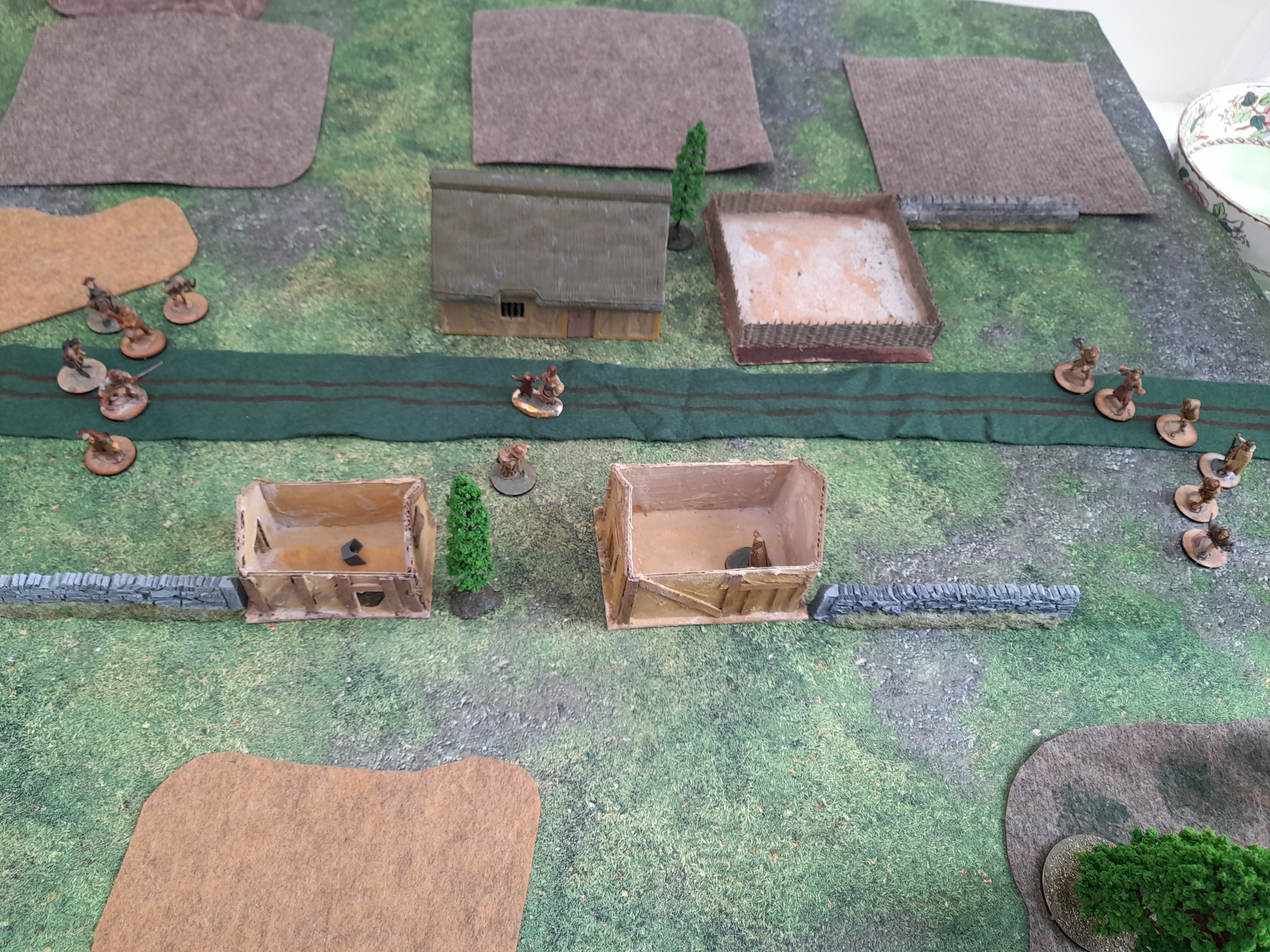
Sir Gilbert and Sir Roland are fighting again.  This time its one of Roland's villages being targeted.  Points are even but Roland gets an additional unit of 12 peasants.

Sir Gilbert
6 Men at Arms
12 Longbowmen

Sir Roland
6 Men at Arms
12 Crossbowmen 
12 Peasants

Sir Gilbert leads my new Perry Men at  arms and archers towards the village.

The street has a barricade thrown up by the local peasants, and Sir Roland appears on the east road with his own men at arms.

Roland brings on the Fireforge crossbowmen. Not sure those "active" poses are what I'm looking for.  Some of those guys appear to be dancing the tango.

And the peasants sneak through the town backsides keeping out of arrow shot.

Sir Gilbert positions and his archers begin to shoot.

And they are deadly.  Six kills on the Crossbows, although I lose an Archer on the return.

And a man at arms Brawl develops in the muddy fields behind the village.


The peasants launch a sneak attack on the bowmen.

Actually a hard fought Melee.  The archers lose three the peasants four.

And the Blue dice of the archers drives the peasants off.  Sir Gilbert wins the day, although he is covered in mud.

Street Fight

 Crying Havoc

Big mouth Giles has done it again, telling Baker that he was an ugly s*d.  Both have gathered their mates, but Baker is friends with the giant village Smith Gobin so things might not be as even as they appear to be.


The village.  Its all about to kick off.

The gangs line up with some women and children in-between.

Gobin stands at rhe front.  Big boy that blacksmith.

And Gules leading his lads shouting and pointing at the blacksmith.  Is that wise?

And the boys close in.  Giles ducks away behind a farmhouse.

Bowyer doing good work with his arrows.

And some scrappy hand to hand scattered around the village.

Baker catches Fletcher.  Giles' Llads are getting the worst of it.

Gobin wallows Giles with his massive forge hammer. Thats going to leave him with a headache!

And Baker is still chasing Fletcher around the village edges.

Caught him  and Fletcher goes down.

Meanwhile Giles is down and his boys are wavering.

Four of Giles band down, one fled.  It's a win for Baker and Gobin.  

And the moral of our tale, the bigger they are the harder they hit you.


Thursday, 10 August 2023

The Sword of Re

With my Egyptian army well under way I wanted a framework for a few games.  This has taken the form of an Ancient Egyptian warship sized for 28mm, "The Sword of Re," and the beginnings of a Sea Peoples raiding ship.

Having seen the raised bronze age wreck at Kyrenia, and the full sized reconstruction in the  Ayia Napa Museum, I take issue with some of the "Reed boat" illustrations.  Those are a misinterpretation of a much smaller type. The reliefs at Medu Habinet clearly show the type of vessels I want, and getting the sheer of the brick build hull correct is important.  The crew will be my Infantry, regulars all. 

Unlike the Sea Peoples and other Tribal organisations the Egyptians differentiate between rowers and  fighting crew.  Stillman and Tallis point out that the whole crew would be comprised of soldiers, and of course these are Marines who can just as easily fight ashore.

For "Sword" the archers my fighting crew aboard, my spearman the rowers. (Although the intention is to use recessed heads in stripy tea towel hats to represent them.)  Ashore the 24 Spearmen take up their weapons to fight in two units flanking the bows

Reed boat reconstruction.  I'll have to have a few of these too.

The reconstructed ship from the bow (the eyes are very much a speculative Greek addition)  The sheer of the hull and the curved deck are distinctive.  The railing would be covered in a warship, offering protection for the crew.

And I was so excited I did a selfie!  Face masks were compulsory!


The seabed archeology is convincing.

The view from the stern is also telling.  Clearly there are huge parallels between the Egyptian and Sea Peoples vessels.  The Kyrenia ship has that keel, rather than a ram, but the steering oar is identical.

On table I have some blue felt sections to act as my river Nile.  The "Sword" will be instrumental in my campaign to throw the Hyksos invaders out of Egypt.  It will also defend the delta against Libyan and Sea People's raids.

My intended tactics of putting the spearmen ashore supported by archers using the ship as a platform may not be entirely historical.  I mean Christian Jacq uses it in his novels but enough said really.  


Monday, 17 July 2023

Flashing that blade

My notes on What a Flasher
The figures I'm planning and the rules mechanisms I'm trialing.  I'm basing this on the work the lardies and particularly Sid have been doing but I want my own feel to it.

The Plan

Using "Blue Moon 28mm"
Plastics as filler ✔ 
Blue Moon Swashbucklers 
Rogues 12 figs ✔ 
Mtd and foot highwaymen 5+5
Mtd and foot 3 Musketeers 5+5 ✔ 
Mounted and foot cardinals guard 5+5
The moving carriage and seated passengers
The duelists actually just more civilians 13 figs
Wagon a basic freight wagon
Terrain
Costed at £150.

The cards.  

Activation on a characters card appearing.
Damage and progress is marked on the card as the game progresses.


Name
Quote
Status (level)
  Action dice
  Menace tokens
  Panache tokens
Skills (from fencing school)
Character
Possessions

Points
Legend, Status IV,  6 points
Blade, Status III,  4 points
Bravo, Status II,  3  points
Slasher, Status I, 2 point
Lackeys, Status Group- 1 point 

Activation
5 dice
1.  Move
2.  Spot an opening
3.  Aim the blade
4.  Slash
5.  Thrust
6.  Flashing Blade


1.  Move
An Action Dice roll of 1 is a Move Dice.  This allows a Character to move. Some movement is simple, such as moving on level, open ground.  Some movement is more challenging, such as crossing obstacles, recovering from a Pin or leaping across a gap between buildings.
2d6 inches for the first dice, 1d6 each additional, obstacles cost one dice, terrain halves distance moved.

2.  Spot an opening, step back.
An Action Dice roll of 2 is a Spot Dice. These allow a Character to spot a target or observe the weakness in an opponent's fighting style and  make hitting a target easier.  Spotting Characters in Cover requires more Spot Dice than spotting someone in the open. 
Also may be used to step back and assess a combat.

3.  Aim the blade/weapon
An Action Dice roll of 3 is an Aim Dice.  Once a Character has spotted a target, they may shoot at it with any Shoot Dice available.  However, a Character can improve their shot by aiming before they shoot. Aim also adds to fighting technique and an Aim Dice make hitting a target is easier.

4.  Slash
An Action Dice roll of 4 may be used to perform a slash with a weapon or as either a Shoot Dice or a single Reload stage. A Shoot Dice allows the Character to fire their weapon.  A Reload Dice of 4 also allows a Character to perform a single Reload stage (of three.)

5.  Thrust
An Action Dice roll of 5 may be used as either a Thrust with the point, or a Reload Dice. A 5 allows the Character to fire their weapon.  A 5 Reload Dice allows a Character to partially load a weapon two stages. 

6.  Flashing Blade
Dice roll of 6 is an Aces High Dice.  An Aces High Dice can be turned into any dice you need or be used to restore Action Dice lost temporarily from the Shock Pool.

Reload stages = 3
I   Pour the Powder
II  Ball and ram
III Prime and cock

Damage roll
1  Riposte
2-3 Parry
4 Scrape, shock
5 A touch, damage
6 A hit, damage and shock

A Riposte allows the defender an attack.

Fights! An alternative system!!

Both players roll initiative.  Add character's status level.  Draw rolls again.
(Both Roll status dice ?)
Multi combats extra figures roll 1 more dice.

1.  Fumble
2.  Step back
3.  Parry
4.  Slash
5.  Thrust
6.  Fencing school

Set the dice against each other high to low.  
Same dice cancel each other out.
Any roll of 1 cannot cancel out a 4, 5 or 6, and a hit is rolled

D6
1-2 a wild miss
3-4 a touch
5-6 a mighty blow

The terrain and scenarios

The Inn at Meung, 
Behind the Luxembourg
The bridge (lined with rickety 3 storied houses)
The town square (same rickety houses)
The Battlefield.  A vauban style ravelin.
The chase, country lanes.
The Docks, ship Decks in 2d/3d style.
The sewers beneath the Bastille


From the FGU game flashing blades

The 1980s Rpg flashing blades has some interesting Character Generation and mini campaign ideas I can use.


Mini Campaign Structure 

A mini campaign is made up of three scenarios or  game sessions.

One player is termed the ‘attacker’. This player  constructs a team that he must preserve and play with  throughout the three games.
The second player is the ‘defender’. He too generates  one or more teams, but he does not have to play with  the same team in every game. In fact it is likely that he  will have a different team to play with each time.  

Each player’s teams should be around 500 points in  value, using the basic model value, and special rules  values. If you feel that this gives one side or the other  too much of an advantage, specifically since the attacker  must carry forward losses to each game, feel free to  adjust the ratios.

The attacker has a specific goal for the campaign that  he must work through the three games to achieve.  Check the Victory Conditions section, below, to see  how to judge success.  For your next campaign, swap attacking and defending  roles. In this way you can build a leader board with  your friends or club mates.

Designing Each Game Scenario The defender can use the following table (or design one  yourself) to find the characteristics of each scenario.
Roll one dice to find if each entry is in the 1 to 3, or 4 to  6 band. Then roll a second dice to find the specific entry.  Roll individually for each column. Feel free to discard  a roll if it comes up with a repeat from a last scenario if  you choose.

For each scenario you will end up with a Where? a  What? a Why? and a Who?

Now you must look at these three sets of information  and work out a story that connects them together.  
Roll 2d6 for each

Where?
Crossroads or  Clearing 
Dungeon
Palace or Manor
Courtyard
A Bridge
Smuggler's cove
The Last Bastion
Village
Aboard ship
Ruins
Enemy camp
Tavern

The Mission
Rescue
Intercept
Deliver
Observe
Kill
Arrest
Avoid arrest
Capture
Destroy
Meet
Guide
Disrupt

Motivation
Revenge
Ordered
Curiosity
Love
Honour
Justice
Duty
Necessity
Glory
Fear
Ambushed/Surprised
Greed

Opposition
Professional  Swordsmen
Guardsmen
Enemies of the country
Highways
Hired killers
Regular military
Militia
Thugs
Fanatics
Gypsies
Civilians
Aristocrats


BERTRAND DES AMIS Maitre en fait d’Armes des Academies du Roi

Italian, "Pronti" jump forwards and lunge,   Bolognese school.

English, "fendente" A mighty blow using the edge, head to the knee.  Dardi school

French, "balestre". The crossbow, a jump to change the rhythm.

German school, "The cross ". A powerful, diagonally descending blow. 

What a Flasher

 I spent the weekend repainting a dozen or so Warlord Games plastic 17th century figures.  They looked pretty good for a random purchase a couple of years back.  This time they were to be the tester for a few games of Flashing blades, and a try at using What a Cowboy rules for some 17th Century swashbuckling.

I am a huge fan of the (frankly dreadful) kids Saturday morning TV series "The Flashing Blade."  I know it all makes no sense, i know the acting is dreadful and I well remember that the BBC failed to show the last twenty minutes when it aired.  Its still magnificent!

My hero is then the Chevalier de Recci, who can best be described as "impetuous."  He revels in the title "the Flashing Blade," although his enemies are less kind.  The period is the War of the Mantuan Succession.  Recci fights for Savoy, and the French, against the dastardly Spaniards.

The games

Somewhere in Turin the Flashing Blade confronts a group of Spaniards.

Recci and his manservant stand their ground.

The manservant doesn't look keen

The Brawl. I was so into this game I forgot to take photos, suffice it to say Recci ran away, again.  What a Cowboy worked well!

Game Two

My newly printed cobblestone effect.  Four euro!

The Spaniards appear

The three Savvoyard swordsmen, and Recci's manservant

Game on.

A great deal of slashing, thrusting and riposting followed.

Recci takes on the Spanish Captain.  Let's hope its not Vigo, as Recci is cut up and down.

As ever the Blade's manservant takes over and beats the Spaniard back.

Recci re-enters the fight and the Spaniard legs it.  A victory for flashers everywhere.